Tirzepatide for weight loss
The largest weight loss of any approved drug, and a head-to-head win over semaglutide — with independent replication that amounts to 24 people.

What is being claimed
That once-weekly tirzepatide produces large, sustained weight loss in adults with obesity — and, in the only published head-to-head, more of it than semaglutide.
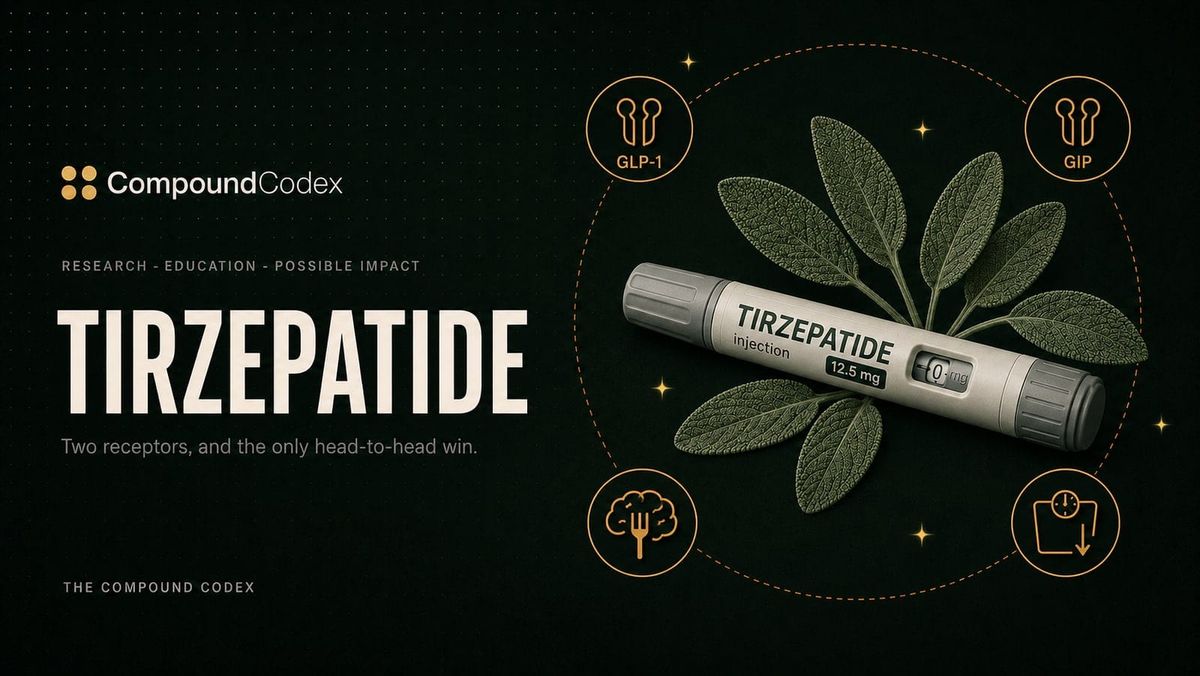
Tirzepatide activates two receptors rather than one: GIP as well as GLP-1. Whether the second receptor is the reason for the larger effect is still argued over. That it produces a larger effect is not.
The trial record
Principal randomised, controlled trials
SURMOUNT-1 randomised 2,539 adults with obesity and no diabetes to 5, 10 or 15 mg weekly or placebo for 72 weeks. Mean weight change was −15.0%, −19.5% and −20.9% against −3.1% on placebo.1
You will more often see 22.5% quoted. Both numbers are from the same trial. −20.9% is the treatment-regimen estimand, which counts everyone as randomised including those who stopped the drug; 22.5% is the efficacy estimand, which describes people who kept taking it as directed. The first answers "what happens if you start this drug", the second "what happens if you stay on it". We quote the first, because the first is the question a reader is actually asking.
SURMOUNT-5 put the two drugs against each other directly: 751 adults, 72 weeks, open-label. Tirzepatide produced −20.2% against semaglutide's −13.7%, with 19.7% of the tirzepatide group losing at least 30% of body weight versus 6.9% on semaglutide.3 The trial was funded by tirzepatide's manufacturer and was not blinded — two facts that belong in the same sentence as the result. All three are set side by side in the GLP-1 comparison.
Who ran the trials
Almost all of them, Eli Lilly. SURMOUNT and SURPASS are company programmes, and so is the head-to-head that beat the competitor's drug.
One published trial was not. TIRTLE1 was a phase 2 double-blind placebo-controlled trial sponsored by the Garvan Institute of Medical Research in Sydney, testing tirzepatide in adults with type 1 diabetes and obesity. It found significant reductions in body weight — predominantly fat mass — alongside reduced insulin requirements.4
TIRTLE1 enrolled 24 people for 12 weeks. It is a real independent replication and we count it as one, because it was designed, run and reported by a group with no stake in the answer. But it is roughly one per cent of SURMOUNT-1 by size.
Our scale counts independent groups without weighting them by size. That is a defensible way to ask "has anyone else checked?" and a poor way to ask "how much did they check?" Readers should know that four dots here rests on an enormous manufacturer-run evidence base plus one small trial from somebody else, and should judge accordingly. This is precisely the kind of thing our challenge process exists to hear about.
Safety and unknowns
-
Boxed warning — thyroid C-cell tumours
In rats, tirzepatide causes dose-dependent and duration-dependent thyroid C-cell tumours at clinically relevant exposures.5 Human relevance is undetermined. Contraindicated in anyone with a personal or family history of medullary thyroid carcinoma or MEN 2.
-
Gastrointestinal effects
Nausea, diarrhoea, vomiting and constipation, mostly mild to moderate, concentrated during the 20-week dose-escalation period and the leading cause of discontinuation.1
-
Lean mass
As with any rapid weight loss, a substantial share of what is lost is lean tissue. TIRTLE1's finding that the loss was predominantly fat mass is encouraging but rests on 24 people over 12 weeks.4
-
Regain on discontinuation
SURMOUNT-4 withdrew the drug after an initial lead-in and participants regained substantial weight. Like semaglutide, this is maintenance therapy, not a course of treatment.
-
Not established
No published cardiovascular outcomes trial of the kind that exists for semaglutide. Tirzepatide has shown larger weight loss; it has not yet shown that this translates into fewer heart attacks and strokes. Those trials are running.
What is actually in the vial
Tirzepatide is approved and prescribable as Mounjaro and Zepbound. The trials above describe that licensed product, titrated over twenty weeks under supervision. They do not describe compounded, research-labelled or imported material of unverified concentration, and the twenty-week escalation schedule exists because starting at the top dose is how people end up unable to keep fluids down.
How the grade was reached
Evidence strength — Strong, criteria checked
The last row is not a criterion our scale requires, and it does not reduce the grade. We show it because semaglutide's page can tick it and this one cannot, and a reader comparing the two deserves to see where the difference lies.
Bottom line
Tirzepatide produces the largest weight loss of any approved drug, and the evidence for it is genuinely strong: a 2,539-person placebo-controlled trial, a three-year extension, a head-to-head win over semaglutide, and consistent pooled findings.
Two things temper it. Independent replication amounts to one 24-person trial, so the evidence base is overwhelmingly the manufacturer's own. And unlike semaglutide, no published trial has yet shown that the weight loss prevents heart attacks or strokes — a gap that is being filled, but is not filled today.
It works, it is approved, and it is better evidenced than almost anything else on this site. It is not yet as completely evidenced as its main competitor.
Sources
- Jastreboff AM, Aronne LJ, Ahmad NN, et al. Tirzepatide once weekly for the treatment of obesity (SURMOUNT-1). New England Journal of Medicine. 2022;387(3):205–216. PMID 35658024. pubmed.ncbi.nlm.nih.gov/35658024
- Jastreboff AM, le Roux CW, Stefanski A, et al. Tirzepatide for obesity treatment and diabetes prevention. New England Journal of Medicine. 2024. PMID 39536238. pubmed.ncbi.nlm.nih.gov/39536238
- Tirzepatide as compared with semaglutide for the treatment of obesity (SURMOUNT-5). New England Journal of Medicine. 2025. Open-label; funded by Eli Lilly. PMID 40353578. pubmed.ncbi.nlm.nih.gov/40353578
- Snaith JR, et al. Tirzepatide in adults with type 1 diabetes: a phase 2 randomized placebo-controlled clinical trial (TIRTLE1). Diabetes Care. 2026;49(1):161. Sponsored by the Garvan Institute of Medical Research. PMID 41264593. pubmed.ncbi.nlm.nih.gov/41264593
- US Food and Drug Administration. Tirzepatide prescribing information — boxed warning, risk of thyroid C-cell tumours. accessdata.fda.gov
- Garvan Institute of Medical Research / EASD 2025. TIRTLE1: tirzepatide reduces weight and insulin requirement in type 1 diabetes. Conference presentation accompanying the published trial. springermedicine.com
- American College of Cardiology. SURMOUNT-5: greater loss of weight and waist circumference with tirzepatide than semaglutide. 2025. acc.org