Retatrutide for weight loss
The largest weight-loss results ever published for a drug of this kind — and the lowest grade we have given to a compound that clearly works.

The unusual shape of this page
Almost every compound we grade low, we grade low because the evidence is thin. Retatrutide is the opposite case. The trials are large, randomised, placebo-controlled, published in the New England Journal of Medicine and The Lancet, and they report the largest weight reductions ever recorded for a drug of this kind.
It still grades Emerging — two dots of four. Not because the findings are doubtful, but because of who ran the trials. Every one of them was funded by the company that owns the molecule, and our rubric requires independent replication before a claim can climb past two dots.
That result is worth sitting with rather than explaining away, so this page spends more time than usual on the grade itself.
What the published trials found
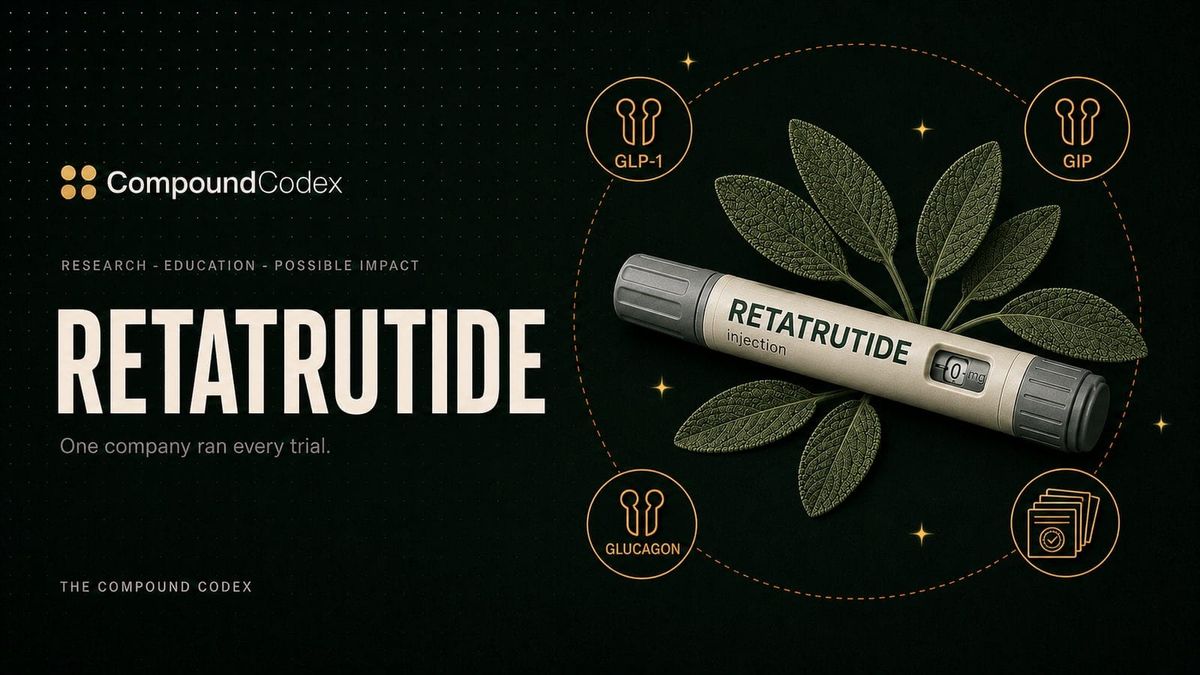
Retatrutide (formerly LY3437943) is a single molecule that activates three receptors at once — GIP, GLP-1 and glucagon. The first two are the targets of the drugs already on the market. The third is the novel part, and it is the reason the weight-loss figures are larger.
Published, placebo-controlled trials
The direction of effect is not in question. In the phase 2 obesity trial, the 12 mg group lost roughly a quarter of their body weight over 48 weeks, against a placebo group that lost about 2%.1 The phase 3 diabetes trial reported HbA1c reductions of up to two percentage points alongside the weight loss, with improvements in non-HDL cholesterol, triglycerides and systolic blood pressure.3
Two independent meta-analyses have pooled the trial data and reached the same conclusion.45 This is why the verdict on this page is Supported and not Mixed. The effect is real, large, dose-dependent, and it has replicated across two distinct populations.
Why it still grades Emerging
Our scale caps a claim at Emerging when fewer than two independent groups have reported on it, and again when all qualifying trials are manufacturer-funded without independent replication. Retatrutide triggers both.
An independent group, by our definition, is a research team sharing no senior authors, no institutional affiliation and no common funding source with the other trials being counted. Every retatrutide trial has been sponsored by Eli Lilly. There is one group. There has never been a second.
The meta-analyses do not solve this. A meta-analysis pools the trials that exist; it cannot manufacture an independent replication that was never run. Pooling three Lilly trials produces a more precise estimate of what Lilly's trials found, not confirmation from anyone else.
This is a genuine limitation of applying our rubric to a drug in active development. Single-sponsor programmes are simply how pharmaceuticals are tested before approval — the FDA does not require a competitor to replicate your results. By our rules, no unapproved drug can exceed two dots, however well it performs. We think that is the right call for a publication whose readers are buying these compounds outside the medical system, but it is a rule reasonable people can contest, and it is open to challenge like anything else here.
What we did not count
The figures circulating most widely — 28.3%, and 30.3% at two years — come from TRIUMPH-1, a phase 3 trial of 2,339 adults with obesity. Lilly announced the topline result in May 2026.6 Two further phase 3 readouts followed.
None of them counts toward the grade yet. Our definition of a qualifying trial requires results posted or published, and a topline press release is neither. It is a company describing its own unreleased data, without the methods, the dropout accounting, the adverse-event tables, or the peer review that lets anyone check the claim.
We expect these trials to publish, and we expect them to be impressive when they do. That expectation is not evidence. When TRIUMPH-1 appears in full, it moves this page — and if independent groups eventually run their own trials, the grade moves further.
Safety and unknowns
-
Common adverse events
Gastrointestinal — nausea, diarrhoea, vomiting — concentrated during dose escalation, dose-related, mostly mild to moderate.1 In the phase 3 diabetes trial, discontinuation for adverse events ran 2.2–5.1% across dose arms against 0% on placebo.3
-
Heart rate
Dose-dependent increases in heart rate were observed, peaking around 24 weeks and declining thereafter.1 This is the finding most worth knowing for anyone self-administering without monitoring.
-
Dysesthesia
Abnormal sensation — tingling, burning, altered touch — was reported in 2.3–4.5% of participants in the phase 3 diabetes trial.3 It is not a class effect of GLP-1 drugs and appears tied to the glucagon component.
-
Serious adverse events
In the phase 2 obesity trial, serious adverse events occurred at similar frequency on drug and placebo — 4% in both.1
-
Longest human exposure on record
Roughly two years, in the TRIUMPH-1 extension — and that data is not yet published. Nothing in the record speaks to use beyond that.
The fact that sits outside the marks
Retatrutide is not approved by any regulator, anywhere. It cannot be legally prescribed, dispensed or compounded. Lilly has said it intends to file for FDA approval in the first quarter of 2027, which would put a decision in late 2027 at the earliest.6
It is nevertheless being sold and injected at scale. Exposures reported to US poison centres averaged around 95 per month over the first four months of 2026 — a 265% increase on the preceding four months.7
Everything on this page describes pharmaceutical-grade retatrutide, administered at a known dose, under medical supervision, in a registered trial. None of it describes material bought from an online vendor. An unapproved compound sold outside the regulated supply chain has no guaranteed identity, purity, concentration or sterility, and the trial results above transfer to it only if it is in fact the same substance at the same dose. That is an assumption, not a finding.
How the grade was reached
Evidence strength — Emerging, criteria checked
Five criteria met, two unmet — and the two unmet ones are the caps. Under our scale a claim cannot pass Emerging until a second group reports, no matter how many of the other boxes are ticked. Retatrutide currently holds more met criteria than several compounds on this site graded above it.
Bottom line
Retatrutide works. Three published randomised trials in 1,156 people show large, dose-dependent weight loss against placebo, replicated in obesity and in type 2 diabetes, and pooled by two independent meta-analyses reaching the same conclusion. The verdict is Supported and we would be misleading you to write anything else.
The two dots are not a statement about whether it works. They are a statement about how many people have checked. Every trial belongs to one company, and until someone with no stake in the answer runs their own, that is what our scale can honestly say.
Separately, and more urgently than the grade: this drug is approved nowhere, the widely-quoted 30% figure comes from a press release rather than a paper, and the version most readers can actually obtain is not the version that was tested.
Sources
- Jastreboff AM, Kaplan LM, Frías JP, et al. Triple–hormone-receptor agonist retatrutide for obesity — a phase 2 trial. New England Journal of Medicine. 2023;389(6):514–526. PMID 37366315. pubmed.ncbi.nlm.nih.gov/37366315
- Rosenstock J, Frias J, Jastreboff AM, et al. Retatrutide, a GIP, GLP-1 and glucagon receptor agonist, for people with type 2 diabetes: a randomised, double-blind, placebo and active-controlled, parallel-group, phase 2 trial conducted in the USA. The Lancet. 2023;402(10401):529–544. PMID 37385280. pubmed.ncbi.nlm.nih.gov/37385280
- Efficacy and safety of retatrutide, a GIP, GLP-1, and glucagon receptor agonist, in people with type 2 diabetes and inadequate glycaemic control with diet and exercise (TRANSCEND-T2D-1): a double-blind, randomised, phase 3 trial. The Lancet. 2026. PMID 42250575. pubmed.ncbi.nlm.nih.gov/42250575
- Effects of once-weekly subcutaneous retatrutide on weight and metabolic markers: a systematic review and meta-analysis of randomized controlled trials. Metabolism Open. 2024. PMID 39318607. pubmed.ncbi.nlm.nih.gov/39318607
- Efficacy and safety of retatrutide, a novel GLP-1, GIP, and glucagon receptor agonist for obesity treatment: a systematic review and meta-analysis of randomized controlled trials. Baylor University Medical Center Proceedings. 2025;38(3). PMID 40291085. pubmed.ncbi.nlm.nih.gov/40291085
- Eli Lilly and Company. Lilly's triple agonist, retatrutide, delivered powerful weight loss in pivotal Phase 3 obesity trial. Investor news release, May 2026. Topline results only; full publication pending. investor.lilly.com
- CBS News. This weight-loss drug hasn't been approved by the FDA. Doctors are prescribing it anyway. 2026. Poison-centre exposure figures. cbsnews.com
- Retatrutide for the treatment of obesity, obstructive sleep apnea and knee osteoarthritis: rationale and design of the TRIUMPH registrational clinical trials. PMID 41090431. pubmed.ncbi.nlm.nih.gov/41090431