Growth hormone for anti-aging
An industry built on twelve men, six months, and no placebo group — and what the seventeen years of controlled trials that followed actually found.

An industry built on twelve men
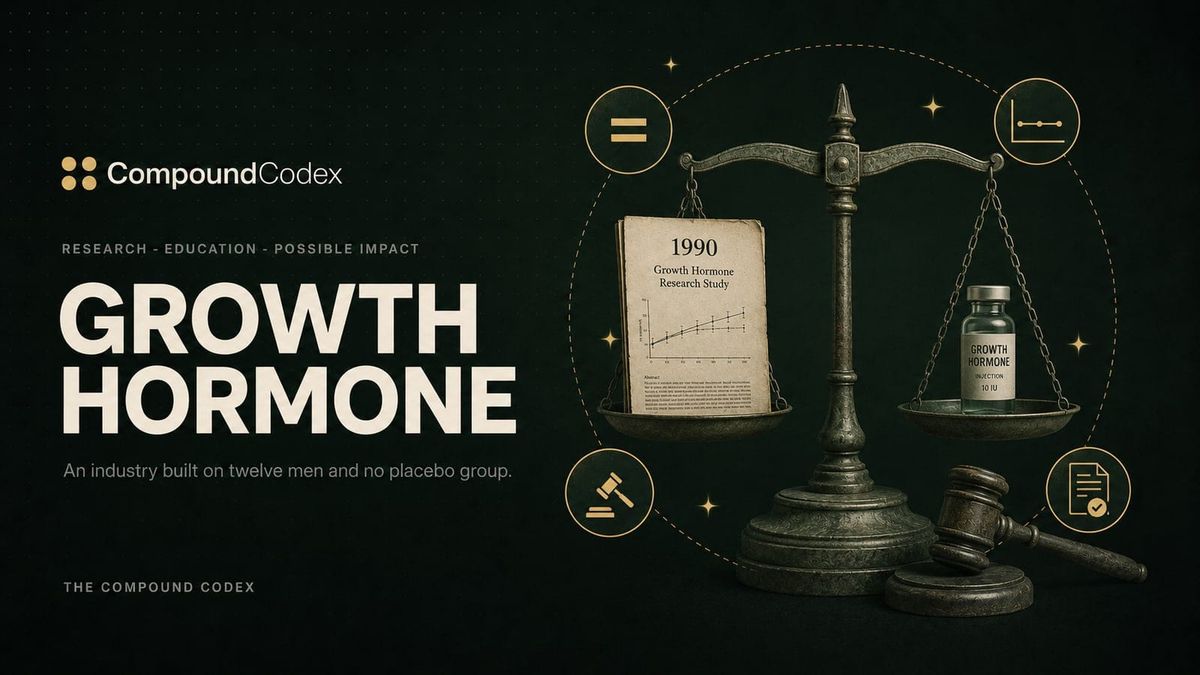
In July 1990 the New England Journal of Medicine published a six-month study of growth hormone in men aged 61 to 81. Twelve received the drug. Nine received nothing. The treated group gained 8.8% lean body mass and lost 14.4% of their fat.1
That paper is the foundation of the entire anti-aging growth hormone industry. It is worth being precise about what it did and did not do.
It was not placebo-controlled — the comparison group received no injection at all. It ran six months in 21 men. And it never measured strength, physical function, or any outcome related to aging. It weighed people and scanned their body composition.
Rudman himself cautioned against extrapolating from it. The journal that published it has since had to say so publicly, more than once, as the study kept appearing in marketing for clinics selling the drug.
The useful question is not what that study found. It is what the seventeen years of properly controlled trials that followed found.
What the controlled trials found
In 2007 a systematic review in the Annals of Internal Medicine pooled the randomised trials of growth hormone against placebo in healthy older adults — 220 treated participants, 107 patient-years, a mean of 27 weeks each.2
Pooled result, healthy older adults
Two kilograms of tissue moved from one column to the other, and nothing else moved at all. Participants were not stronger. They did not walk faster or climb stairs better. They did not report feeling better. Their bones were no denser.
This is the distinction the marketing depends on you not making. Body composition changed. The person did not. A scan showing less fat and more lean tissue is a measurement, not a benefit — and when the trials looked for the benefit that was supposed to follow, it was not there.
Three claims, three answers
The third row is the one the drug is sold for, and it is the one nobody has tested. No trial has measured lifespan, healthspan, or any accepted marker of biological aging under growth hormone. The claim is not contradicted by evidence; it has never been examined.
Safety and unknowns
-
Adverse events, significantly increased
Pooled across the controlled trials, participants on growth hormone were significantly more likely to experience soft-tissue oedema, joint pain, carpal tunnel syndrome and gynaecomastia.2 These are not rare footnotes; they were the ordinary experience of treatment.
-
Glucose metabolism
Treated participants were also more likely to develop impaired fasting glucose and diabetes.2 Growth hormone antagonises insulin; this is a mechanistic consequence, not a coincidence.
-
Cancer
Growth hormone raises IGF-1, and higher IGF-1 is associated with increased risk of several cancers in observational data. No trial has been long enough or large enough to test whether treating healthy adults changes cancer incidence. This is a genuine unknown, not a cleared concern.
-
Longest controlled exposure
A mean of 27 weeks.2 Nothing in the controlled record speaks to years of use, which is how it is actually sold.
The legal fact that has no equivalent
Growth hormone occupies a position no other drug in the United States holds. Under 21 U.S.C. § 333(e), distributing or possessing it with intent to distribute for any purpose other than an FDA-approved indication is a federal felony, carrying up to five years' imprisonment.3
Off-label prescribing is normal, legal medical practice for essentially every drug in the pharmacopoeia. Growth hormone is the exception written into statute. Congress singled it out.
Which means a clinic prescribing it for "age management", "wellness" or bodybuilding is not operating in a grey area or exercising clinical judgement. It is committing a federal crime, and people have gone to prison for it.
Its lawful indications are narrow: growth hormone deficiency from specific pituitary disease, certain paediatric growth disorders, and HIV-associated wasting. Aging is not among them, and no regulator anywhere has approved it as one.
What this means for MK-677
We grade MK-677 as Emerging · Supported for raising growth hormone and IGF-1. It does that; the trials are clear.
This page is the reason that grade matters less than it sounds. Raising growth hormone is a mechanism, and the mechanism has now been tested directly, with the hormone itself, at doses that unambiguously work. What it produced was two kilograms of recomposition, no functional benefit, and a meaningful burden of side effects.
A compound that raises growth hormone is inheriting that result, not escaping it.
How the grade was reached
Evidence strength — Moderate, criteria checked
Three unmet criteria hold this at Moderate rather than Strong, and all three are about scale: growth hormone trials in healthy people are small and short, because giving a powerful hormone to people who do not need it is difficult to justify for long. The evidence is consistent and pooled; there is simply not very much of it.
Bottom line
Growth hormone moves about two kilograms of fat into lean tissue in healthy older adults, and does nothing else that has been measured. It does not make people stronger, faster on their feet, better able to climb stairs, or happier with their lives. It does reliably cause swelling, joint pain, carpal tunnel syndrome and glucose problems.
The claim it is actually sold under — that it slows aging — has never been tested in a human trial, seventy years after the hormone was isolated and thirty-six after the study that started the industry.
And it is the one drug in America that Congress made it a felony to prescribe for exactly this purpose.
Sources
- Rudman D, Feller AG, Nagraj HS, et al. Effects of human growth hormone in men over 60 years old. New England Journal of Medicine. 1990;323(1):1–6. PMID 2355952. pubmed.ncbi.nlm.nih.gov/2355952
- Liu H, Bravata DM, Olkin I, et al. Systematic review: the safety and efficacy of growth hormone in the healthy elderly. Annals of Internal Medicine. 2007;146(2):104–115. PMID 17227934. pubmed.ncbi.nlm.nih.gov/17227934
- United States Code. 21 U.S.C. § 333(e) — prohibited distribution of human growth hormone. law.cornell.edu/uscode/text/21/333
- Perls TT, Reisman NR, Olshansky SJ. Provision or distribution of growth hormone for "antiaging": clinical and legal issues. JAMA. 2005;294(16):2086–2090. PMID 16249424. pubmed.ncbi.nlm.nih.gov/16249424
- Vance ML. Can growth hormone prevent aging? New England Journal of Medicine. 2003;348(9):779–780. Editorial on the misuse of the 1990 trial. PMID 12606732. pubmed.ncbi.nlm.nih.gov/12606732
- US Food and Drug Administration. Somatropin prescribing information — approved indications. accessdata.fda.gov