Creatine monohydrate for strength and lean mass
Does taking creatine alongside resistance training build more muscle and strength than training alone?

What it is
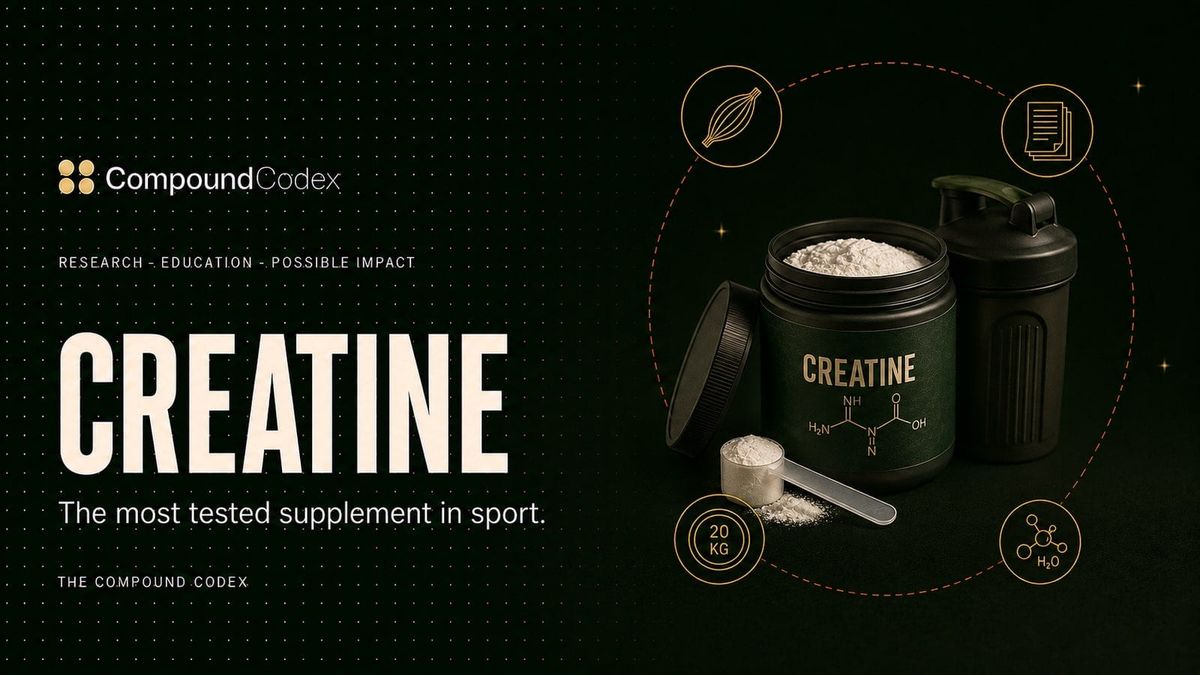
Creatine is a compound your body already makes from three amino acids, and that you already eat in meat and fish. Roughly 95% of it is stored in skeletal muscle as phosphocreatine, where it serves as a rapid-recharge system for ATP — the molecule your cells actually spend for energy.
During short, hard efforts — a heavy set, a sprint — muscles burn through ATP within seconds. Phosphocreatine donates a phosphate group to rebuild it on the spot. Supplementing raises the amount of phosphocreatine stored in muscle, which in principle means slightly more work completed before fatigue. Across weeks of training, marginally more work per session is the proposed route to more adaptation.4
That's the mechanism. The question is whether it produces changes anyone can measure.
What the trials found
Creatine is among the most heavily studied compounds in sports nutrition. A 2003 meta-analysis screened 96 peer-reviewed papers covering 100 separate studies2, and the literature has grown substantially since.
The most recent systematic review pooled 37 randomized controlled trials in young men, separating those who resistance-trained from those who didn't.1 Among trainees, creatine groups outperformed placebo groups on both body composition and squat strength.
Pooled results, creatine vs. placebo during resistance training
The lower bound of every significant confidence interval sits above zero, which is what distinguishes a replicated finding from a hopeful one. Independent research groups across multiple countries and decades have converged on the same direction of effect.
How big is it, really
This is where most coverage of creatine stops being useful, because "statistically significant" and "worth your money" are different questions.
The 2003 meta-analysis reported an effect size for body composition of 0.172 — small by any conventional reading. A gain of roughly 2.7 kg of lean mass over a training block is real and worth having, but it is an augmentation of what training already does, not a substitute for it. The placebo groups in these trials also gained muscle. They gained it by lifting.
One measurement caveat that matters: creatine draws water into muscle cells, and DXA-measured "lean mass" counts that water. Some portion of early lean-mass gain — particularly in the first weeks — is intracellular fluid rather than new contractile tissue. This does not make the strength findings spurious, but it does mean the scale moves faster than the muscle does.
Note also the split within the strength data: squat one-rep max improved substantially, while leg press showed no significant effect.1 Benefits appear concentrated in specific movements and testing protocols rather than distributed evenly across everything you might measure.
Where the evidence pushes back
A 2025 randomized controlled trial in 63 adults is the most interesting dissent in the recent literature.3 Participants took 5 g/day of creatine monohydrate through a 12-week supervised resistance training program.
Both groups gained roughly 2 kg of lean mass. Between them there was no significant difference (p=0.71). The authors concluded that 5 g/day "did not enhance lean body mass growth when combined with resistance training," and proposed that higher maintenance doses may be required.
Under our conflict rule, a single trial does not overturn a body of meta-analyzed evidence — but it does point at a variable worth naming. Many of the trials feeding the positive meta-analyses used a loading protocol (around 20 g/day for five days) before dropping to a maintenance dose. This trial did not. Whether loading is necessary, or whether 5 g/day alone is simply too little, is a genuinely open question that the next few years of trials should settle.
The verdict remains Supported because meta-analysis governs and the pooled direction is clear. But readers should know the dissent exists, and that it comes from a recent, competently run study.
Safety and unknowns
-
Adverse events reported
Gastrointestinal discomfort and water retention are the commonly reported effects, generally at loading doses. The ISSN position stand concludes that short- and long-term supplementation is safe in healthy adults at studied doses.4
-
Kidney function
The most direct test remains a 12-week randomized, double-blind trial in resistance-trained adults eating a high-protein diet (20 g/day for 5 days, then 5 g/day). Glomerular filtration rate measured by 51Cr-EDTA clearance showed no group difference (p=0.64), and creatinine clearance, urea, electrolytes, proteinuria and albuminuria were unchanged.5 Note the sample was small — 26 participants analyzed.
-
Longest human exposure studied
The ISSN position stand reports supplementation of up to five years in healthy athletes without evidence of renal impairment.4 Most individual trials run 4 to 12 weeks.
-
Regulatory status
Sold as a dietary supplement in the United States. Not prohibited by the World Anti-Doping Agency.
-
What has not been characterized
Safety data come overwhelmingly from healthy adults. People with existing kidney disease have not been adequately studied and should not extrapolate from these trials. Long-term data in adolescents, pregnancy, and older adults with comorbidities are thin. Product purity varies by manufacturer and is not addressed by any trial cited here.
Safety findings above describe the doses and durations used in published trials, in the course of describing those trials. They are not a recommendation, and this breakdown does not tell you what to take. Talk to a clinician who knows your history — particularly if you have any kidney condition.
How this was graded
Evidence strength — Strong, criteria checked
Individual creatine trials are typically small — most enrol 20 to 40 participants. Confidence here comes from the sheer number of independent replications and their meta-analytic pooling, not from any single large trial.
Bottom line
Creatine monohydrate does what it is claimed to do, and it is one of the few supplements about which that sentence can be written without qualification about study quality.
What it does is smaller than the marketing implies. It amplifies the results of training you were already going to do — by a couple of kilograms of lean mass over a training block, some of it water — and it does nothing at all for someone who isn't training. The recent null result at 5 g/day without loading is a real open question, not a footnote.
Sources
- Gu J, Li Y, Xiao J, Zhang Y. Creatine supplementation in young men under resistance versus non-resistance training: a systematic review and meta-analysis of strength, performance, and lean mass. Frontiers in Nutrition. 2026;13:1800546. doi:10.3389/fnut.2026.1800546
- Branch JD. Effect of creatine supplementation on body composition and performance: a meta-analysis. International Journal of Sport Nutrition and Exercise Metabolism. 2003;13(2):198–226. PMID 12945830
- Desai I, Pandit A, Smith-Ryan AE, et al. The effect of creatine supplementation on lean body mass with and without resistance training. Nutrients. 2025;17(6):1081. PMC11944689
- Kreider RB, Kalman DS, Antonio J, et al. International Society of Sports Nutrition position stand: safety and efficacy of creatine supplementation in exercise, sport, and medicine. Journal of the International Society of Sports Nutrition. 2017;14:18. PMID 28615996
- Lugaresi R, Leme M, Painelli VS, Murai IH, Roschel H, Sapienza MT, Lancha AH Jr, Gualano B. Does long-term creatine supplementation impair kidney function in resistance-trained individuals consuming a high-protein diet? Journal of the International Society of Sports Nutrition. 2013;10:26. PMC3661339